
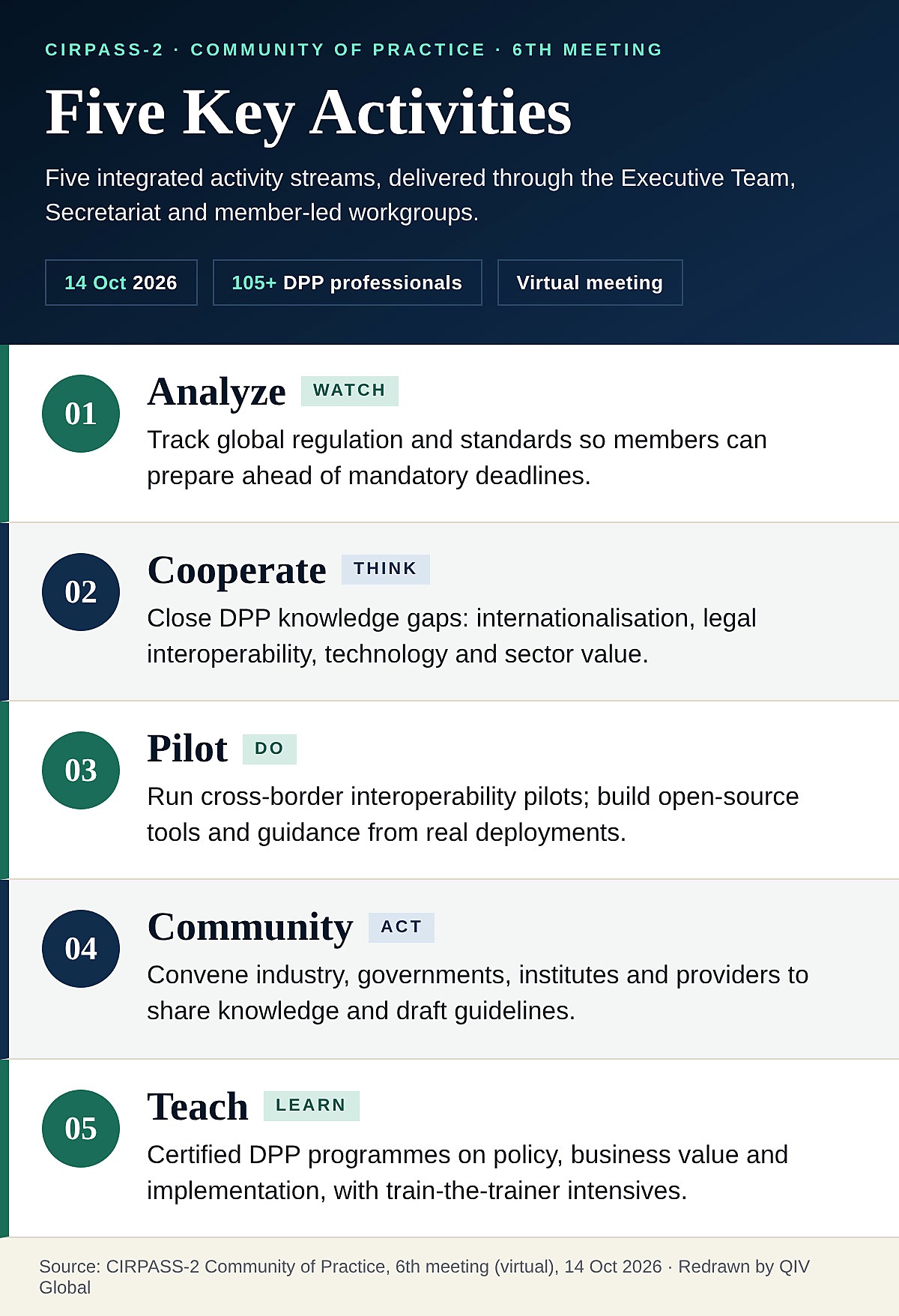
Five Key Activities — redrawn by QIV Global from the CIRPASS-2 Community of Practice 6th meeting (virtual), 14 October 2026.
The five activity streams of the CIRPASS-2 Community of Practice.
On 14 October 2026, more than 105 Digital Product Passport (DPP) professionals joined a virtual meeting organised by CIRPASS-2 — the sixth gathering of its Community of Practice (CoP). CIRPASS-2 is the EU-funded project, running from 2024 to April 2027 under the Digital Europe Programme, that is preparing the ground for the Digital Product Passport required under the EU's Ecodesign for Sustainable Products Regulation, including pilots across several product sectors. QIV Global was among the participants.
The session centred on a single organising idea: five integrated activity streams, delivered through the project's Executive Team, Secretariat and member-led workgroups. Each carries a plain-language verb — Watch, Think, Do, Act, Learn.
Analyze (Watch). Monitor and synthesise global developments on regulations and standards, giving members priority intelligence so they can prepare ahead of mandatory deadlines. Cooperate (Think). Close DPP knowledge gaps on internationalisation, legal interoperability, technology and value creation in different sectors.
Pilot (Do). Run cross-border interoperability pilots that prove the DPP in practice, and build and disseminate open-source tools and guidance drawn from real deployments in multiple sectors. Community (Act). Convene industry, governments, innovation institutes and DPP service providers for knowledge-sharing, matchmaking, joint problem-solving, and the drafting of guidelines and implementation recommendations.
Teach (Learn). Certified programmes covering DPP policy, business value and technical implementation, delivered online by leading DPP experts, with face-to-face train-the-trainer intensives and certificates on completion.
For buyers and QA teams, two points stand out. First, a turnout above 105 for a working-level community meeting is a signal that the DPP is moving from policy discussion to implementation. Second, the “Pilot” stream is where the practical questions get answered: a passport that works inside one system but cannot be read by another is of limited use in an international supply chain, which is why cross-border interoperability is the test that matters.
It also reinforces a point made throughout this library: DPP data has to be verified, not merely declared. As textile, electronics and other category rules are finalised, independent inspection and audit records are the evidence that gives passport data its credibility. We will continue to follow the CoP's guidance and pilot results and report what they mean for inspection and supplier verification.
Want the monthly version of insights like this? Subscribe to the QIV Insight.